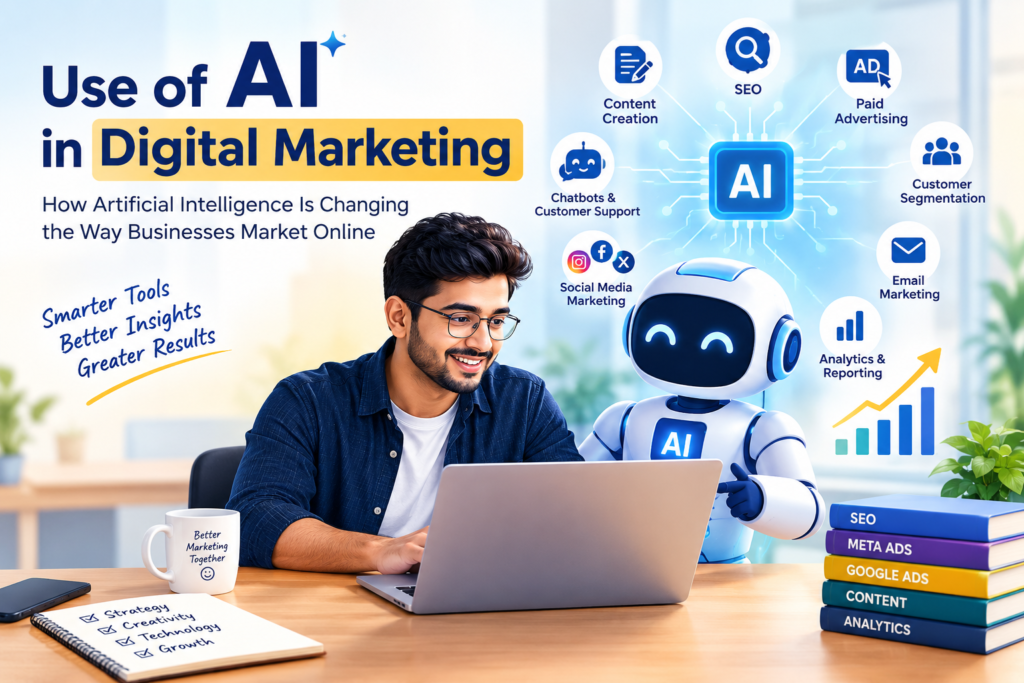
Artificial Intelligence (AI) is no longer just a futuristic technology. It has become a practical part of modern digital marketing.
From writing ad copy and generating content to analyzing customer behavior, optimizing campaigns, personalizing experiences, and improving SEO, AI is helping marketers work faster and make better data-driven decisions.
But there is an important question:
Is AI going to replace digital marketers?
Not exactly.
AI is changing how marketers work, but human creativity, strategy, emotional understanding, and decision-making are still essential. The marketers who learn how to use AI effectively are likely to have a significant advantage over those who ignore it.
In this blog, let’s understand how AI is used in digital marketing, its benefits, practical applications, challenges, and how businesses can use AI to improve their marketing results.
What Is AI in Digital Marketing?
AI in digital marketing means using artificial intelligence technologies to analyze data, understand customer behavior, automate repetitive tasks, generate content, predict outcomes, and improve marketing campaigns.
Traditional digital marketing often requires marketers to manually collect data, analyze reports, create content, manage campaigns, and identify customer patterns.
AI can assist with many of these activities in seconds.
For example:
Traditional approach:
Data → Manual analysis → Strategy → Content → Campaign → Optimization
AI-assisted approach:
Data → AI insights → Human strategy → AI-assisted execution → Testing → Optimization
The goal is not to remove humans from the process.
The goal is to help marketers make smarter decisions with less repetitive work.
Why Is AI Important in Digital Marketing?
Digital marketing generates enormous amounts of data.
Every day, businesses receive information from:
- Google Ads
- Meta Ads
- Website analytics
- Search engines
- Social media
- Email campaigns
- CRM systems
- E-commerce platforms
- Customer interactions
- Chatbots
- Reviews
Analyzing all this information manually can take significant time.
AI can process large amounts of data and identify patterns that may not be immediately obvious to humans.
For example, AI can help marketers identify:
- Which audience is converting?
- Which creative is generating better engagement?
- Which keywords are driving qualified traffic?
- Which customers are likely to purchase?
- Which leads are more valuable?
- Which campaign is wasting budget?
- What type of content customers are interested in?
This makes AI particularly valuable for data-driven digital marketing.
10 Major Uses of AI in Digital Marketing
Let’s explore some of the most important applications of AI in digital marketing.
1. AI-Powered Content Creation
One of the most common applications of AI is content creation.
AI tools can help marketers generate:
- Blog ideas
- Social media captions
- Ad copy
- Email drafts
- Product descriptions
- Video scripts
- Headlines
- Meta titles and descriptions
- Content outlines
- FAQs
For example, instead of spending an hour brainstorming 20 Facebook ad headlines, a marketer can use AI to generate multiple variations and then select and improve the strongest ones.
However, AI-generated content should not simply be copied and published.
A better workflow is:
AI generates → Marketer reviews → Marketer adds expertise → Fact-check → Optimize → Publish
This creates content that combines AI efficiency with human expertise.
2. AI for SEO
AI is significantly changing the way marketers approach Search Engine Optimization (SEO).
AI can help SEO professionals with:
- Keyword research
- Search intent analysis
- Content ideas
- Topic clustering
- Content briefs
- Competitor analysis
- Internal linking suggestions
- Meta title generation
- Meta description creation
- Content optimization
- SERP analysis
For example, instead of targeting only one keyword such as:
“digital marketing agency in Pune”
an SEO professional can use AI-assisted research to understand related search topics and user intent, such as:
- Digital marketing services in Pune
- SEO agency in Pune
- Google Ads agency in Pune
- Social media marketing agency in Pune
- Digital marketing company for small businesses
- Performance marketing agency in Pune
The important point is that AI should support SEO strategy, not replace it.
Search engines ultimately care about whether content is useful, relevant, trustworthy, and valuable to users.
3. AI in Paid Advertising
AI has become an important part of platforms such as Google Ads and Meta Ads.
Advertising platforms use machine learning to analyze signals and optimize campaign delivery.
AI can help marketers with:
- Audience prediction
- Ad delivery
- Budget allocation
- Bid optimization
- Creative recommendations
- Conversion prediction
- Campaign optimization
- Performance forecasting
For example, suppose you are running a lead-generation campaign.
Instead of manually deciding which individual users should see an advertisement, the advertising platform can analyze thousands of signals and identify users who are more likely to take the desired action.
This allows marketers to focus more on:
Offer + Creative + Audience Strategy + Tracking + Optimization
rather than manually controlling every delivery decision.
4. AI for Customer Segmentation
Not every customer behaves in the same way.
A business may have:
- New visitors
- Returning visitors
- First-time buyers
- High-value customers
- Cart abandoners
- Engaged users
- Inactive customers
AI can analyze customer behavior and help businesses create more meaningful segments.
For example:
A customer who purchased a product three times may be more valuable than someone who visited the website once.
AI can identify such behavioral patterns and help marketers create targeted campaigns.
This can improve:
Personalization → Engagement → Conversion → Customer Lifetime Value
5. AI-Powered Personalization
Customers expect brands to understand their needs.
Imagine visiting an e-commerce website and seeing recommendations based on your previous browsing and purchasing behavior.
That is personalization.
AI can help businesses personalize:
- Product recommendations
- Email campaigns
- Website experiences
- Offers
- Advertisements
- Content
- Notifications
For example:
Instead of sending the same email to 50,000 customers, AI can help marketers deliver different recommendations based on customer interests and behavior.
This can make marketing communication more relevant.
6. AI Chatbots and Conversational Marketing
AI-powered chatbots are becoming increasingly popular.
A chatbot can assist customers with questions such as:
“What is the price?”
“Do you provide home delivery?”
“What are the course timings?”
“How can I book a demo?”
“Is this product available in my location?”
Instead of waiting for a sales representative, customers can receive immediate responses.
For businesses, this can help with:
- Lead qualification
- Customer support
- FAQs
- Appointment booking
- Product recommendations
- Lead generation
- 24/7 customer communication
However, complex customer problems may still require human assistance.
7. AI for Social Media Marketing
Managing multiple social media platforms can be time-consuming.
AI can assist social media marketers with:
- Content ideas
- Captions
- Hashtag suggestions
- Content calendars
- Audience insights
- Social listening
- Sentiment analysis
- Creative ideas
- Performance analysis
For example, AI can analyze your previous posts and identify which topics generated higher engagement.
A marketer can then use those insights to develop future content.
But simply generating hundreds of AI posts isn’t a social media strategy.
Strategy comes first. AI comes second.
8. AI for Email Marketing
Email marketing becomes more powerful when communication is personalized.
AI can help marketers determine:
- What content should be sent?
- Who should receive it?
- When should it be sent?
- Which subject line may perform better?
- Which customers are likely to convert?
For example, an e-commerce brand could send different emails to:
New customer:
Welcome + first-purchase offer
Existing customer:
Product recommendation
Inactive customer:
Re-engagement campaign
High-value customer:
Exclusive offer
This makes email marketing more relevant than sending one generic message to everyone.

9. Predictive Analytics
One of the most powerful applications of AI is predicting future behavior.
AI can analyze historical data and identify patterns that can help marketers estimate:
- Customer churn
- Purchase probability
- Lead quality
- Customer lifetime value
- Campaign performance
- Demand trends
For example, if a company has historical customer data, AI may help identify characteristics shared by customers who are more likely to purchase.
Marketers can then use these insights to prioritize high-quality leads.
10. AI for Marketing Analytics and Reporting
Digital marketers spend a significant amount of time analyzing campaign performance.
AI can help summarize large amounts of marketing data and identify important trends.
Instead of simply looking at:
CTR: 2.5%
CPC: ₹18
CPL: ₹350
Conversion Rate: 4%
AI-assisted analysis can help marketers ask a more important question:
“Why is the campaign performing this way, and what should we change?”
For example:
“The campaign is generating a good number of clicks, but the conversion rate is low. This may indicate a mismatch between the ad promise and landing page experience.”
That type of insight is much more useful than simply looking at numbers.